
AETC Program Map and Directory
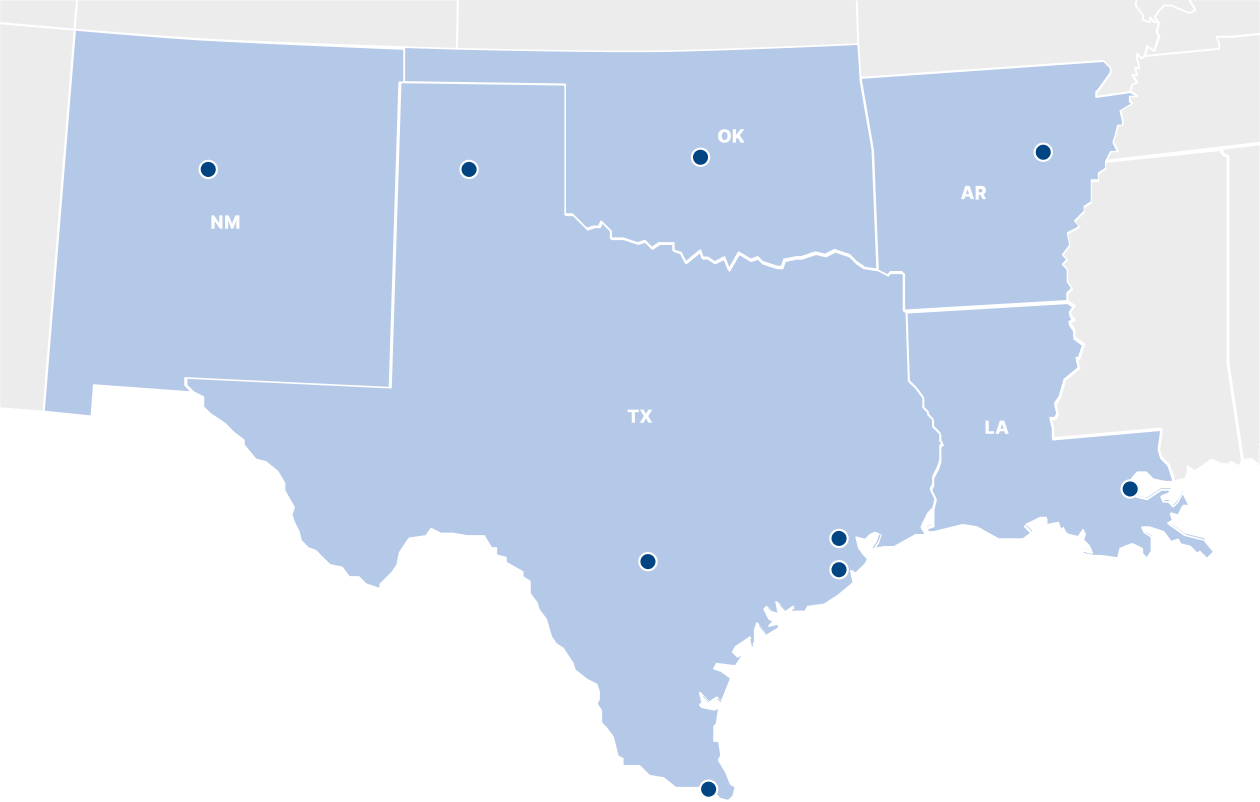
The AETC Program provides health care providers comprehensive training and educational tools in the treatment and prevention of HIV/AIDS, and the South Central AETC serves the states of Arkansas, Louisiana, New Mexico, Oklahoma, and Texas through its central office and local partners.
Local and regional services are provided throughout those five states via a network of Local Partner Sites. Each local partner site has its own qualified faculty, programs, and activities designed to meet the needs of their local region or state. Our partners are based at academic medical centers, community clinic settings or community-based organizations, with access to highly qualified HIV specialists.
We are privileged to work with our partners throughout the South Central region. Explore the map to learn about each state, and select your local partner to learn more about their AETC services.
Our Partners
Arkansas
Arcare
Arkansas SCAETC Local Partner under the Arcare umbrella serves the entire state of Arkansas, working statewide to strengthen HIV Prevention, Care, and Treatment through education and training services as an EHE priority state.
In 2023, Arkansas had 6,493 people living with diagnosed HIV with 63% virally suppression, 70% receiving care, and 34% ever tested for HIV. Also in 2023, Arkansas had over 300 newly diagnosed HIV cases, highlighting a need for ongoing education.
The Arkansas SCAETC Local Partner focuses on collaborations with other community and state organizations to create capacity-building as well as educating and training health care team members that are new to HIV care and prevention as well as experienced staff who need expert support.
Email: AETC@arcare.net
Louisiana
As part of the Ending the HIV Epidemic (EHE) in the U.S. initiative, Louisiana’s efforts include development and provision of training that strengthen healthcare workforce understanding of prevention, care, and treatment of HIV.
As reported within the Louisiana Department of Health STD/HIV/Hepatitis Program in 2023 by Region Factsheets, the New Orleans Eligible Metropolitan Area (NOEMA) reported 210 new HIV diagnoses and 62% of new diagnosis were from Orleans Parish. In Region 2, 169 new HIV diagnoses with the majority, 76%, were from East Baton Rouge Parish.
New Mexico
The University of New Mexico, through project ECHO, serves as the SCAETC site for New Mexico. The UNM SCAETC Local Partner site works statewide to strengthen and expand HIV education, clinical training, and community partnerships. The UNM SCAETC site build and sustain collaborations with the NM Department of Health, tribal communities, Pueblos, and sovereign Indian Nations, and other stakeholders within the state.
New Mexico has experienced fluctuating rates of new HIV diagnoses, with a rate of 9.8 per 100,000 in 2020, following rates of 8.2-8.6 between 2016-2019. Approximately 87.3% of New Mexicans with HIV are aware of their status, slightly better than the national average. As of 2023, approximately 4,139 people are living with HIV/AIDS in the state.
Oklahoma
University of Oklahoma Health Sciences Center
The Oklahoma site of the South Central AIDS Education and Training Center (SCAETC) strengthens statewide HIV provider capacity through targeted clinical education, workforce development, and partnerships that expand access to high-quality HIV prevention and care across the state, including in Native American and rural communities. This work directly supports the goals of the national Ending the HIV Epidemic (EHE) initiative by improving provider readiness and reducing barriers to care. In 2023, Oklahoma reported 7,677 people living with diagnosed HIV (228 per 100,000) and 385 new HIV diagnoses. While 79.5% of people living with HIV received care, only 61.5% were virally suppressed—underscoring the continued need for provider training to improve treatment outcomes and long-term retention in care. Additionally, only 32.9% of Oklahomans have ever been tested for HIV, reinforcing the importance of expanding routine testing and early diagnosis through clinical and community-based capacity-building efforts.
Texas
The University of Texas Medical Branch (UTMB), through the South Central AIDS Education and Training Center, serves as a Texas SCAETC site, providing HIV education and clinical training to enhance the healthcare workforce both locally and statewide. SCAETC UTMB Local Partner site focuses on the Coastal Region, particularly for training healthcare professionals who serve correctional populations, including those in the Texas Department of Criminal Justice (TDCJ) system. In collaboration with UTMB faculty and clinical partners, UTMB partner supports HIV training in the Coastal Region, ensuring care for thousands of individuals living with HIV while advancing education and implementation efforts across Texas.
In 2023, approximately 3,443 people were diagnosed with HIV in the Coastal Region, with Galveston County accounting for 1,287 of these cases, or about 37% of the regional total. That year, Galveston County also reported 54 new HIV diagnoses. The rates of HIV prevalence and diagnosis in this region are comparable to or exceed the averages for Texas, emphasizing the ongoing need for education, prevention, and treatment efforts, especially in correctional and other high-need care settings.
Baylor College of Medicine (BCM), through the Houston AIDS Education and Training Center (Houston AETC), serves as a Texas SCAETC site, working locally and statewide to strengthen HIV education, clinical training, and community partnerships. Locally, BCM focuses on Houston/Harris County and surrounding areas, an EHE priority jurisdiction.
In 2022, the Houston Eligible Metropolitan Area reported 1,413 new HIV diagnoses, with the majority in Houston/Harris County. By year’s end, 33,397 people were living with diagnosed HIV in the Houston EMA—approximately 91% residing in Houston/Harris County. HIV prevalence and new diagnosis rates in this region continue to exceed state and national averages, highlighting the ongoing need for sustained education and capacity-building efforts.
The University of Texas at San Antonio
The University of Texas at San Antonio (UTSA), South Central AETC develops HIV-related educational and training opportunities for Central, North and South Texas providers and clinic staff to help fill in gaps found in the HIV care continuum. UTSA expands and covers four EHE priority jurisdictions in Texas- Bexar, Travis, Dallas, and Tarrant Counties, all high burden areas for new HIV diagnosis.
In 2023, the counties reported the following new HIV diagnoses, Bexar- 385, Travis- 209, Dallas- 831, and Tarrant- 336 cases making up 35% of new HIV cases in Texas. At the end of 2023, 42,660 people were living with a HIV diagnosis. Texas continues to rank as the second highest state in the Unites States with new HIV cases, further highlighting the need for education and training along the HIV care continuum with a priority focus on HIV prevention.
Valley AIDS Council (VAC), as a Texas SCAETC local performance site, strengthens HIV workforce development and clinical capacity-building across West Texas, including communities in Cameron, Hidalgo, Starr, Willacy, Webb, Maverick, and El Paso counties. These areas face unique challenges related to geographic isolation, limited healthcare access, language barriers, and cross-border health dynamics.
Through targeted training, technical assistance, and implementation of evidence-based HIV care protocols and national clinical guidelines, VAC helps strengthen high-quality HIV care delivery for historically underserved communities. Partnerships with community health centers, public health agencies, and clinical providers expand routine HIV testing, strengthen linkage and retention in care, improve viral suppression outcomes, and support of PrEP integration in rural and border settings.
Ongoing regional needs highlight the importance of continued clinical development and coordinated capacity-building efforts across this region.
Panhandle AIDS Support Organization
Panhandle Assistance and Support Organization (PASO) is a Local Partner Site, providing locally based, targeted education, clinical consultation, and technical assistance to healthcare professionals and healthcare organizations.
Map Content (not displayed on front end)
Arkansas
Arkansas
Latest available data (2023) indicate that in Arkansas, 6,493 people were living with HIV, and 63.0% were virally suppressed. 70.8% of people living with HIV received care, the lowest percentage in the region. 34.6% of the population had ever been tested for HIV, and there were 304 new diagnoses.
Louisiana
Louisiana
In Louisiana, 22,229 people were living with HIV, and 72.8% were virally suppressed. 81.2% of people living with HIV received care. 44.8% of the population had ever been tested for HIV, and there were 858 new diagnoses. Louisiana has the highest rate of HIV in the region, with 582 people per 100,000 living with HIV.
New Mexico
New Mexico
In New Mexico, 4,134 people were living with HIV, and 67.8% were virally suppressed. 74.5% of people living with HIV received care. 35.8% of the population had ever been tested for HIV, and there were 187 new diagnoses.
Oklahoma
Oklahoma
In Oklahoma, 7,677 people were living with HIV, and 61.5% were virally suppressed. 79.5% of people living with HIV received care. 32.9% of the population had ever been tested for HIV, and there were 385 new diagnoses. Oklahoma has the lowest percentage of people who were ever tested for HIV, and the lowest percentage of patients who were virally suppressed.
Texas
Texas
In Texas, 110,094 people were living with HIV, and 66.6% were virally suppressed. 77.0% of people living with HIV received care. 40.1% of the population had ever been tested for HIV, and there were 5,075 new diagnoses. The SCAETC supports HIV prevention, testing, care, and workforce development across Texas through four local performance sites, Baylor College of Medicine, University of Texas San Antonio, University of Texas Medical Branch and Valley AIDS Council. Note: State-level percentages reflect AIDSVu-published values. Source: AIDSVu (CDC HIV Surveillance Data)
The National AETC Program
The AETC Program is the clinical training and support arm of the HRSA HIV/AIDS Bureau (HAB) Ryan White HIV/AIDS Program. Through comprehensive healthcare workforce education, clinical consultation, and technical assistance, the AETC Program enhances the quality of HIV care outcomes for people with HIV and communities impacted by HIV across the United States and its territories.